r.noaa.atlas14
Downloads and imports NOAA Atlas 14 precipitation-frequency data from the PFDS point service or official GIS grid packages.
r.noaa.atlas14 [-lkcio] mode=string [statistic=string] [units=string] [series=string] [bound=string] [coordinates=lon,lat [,lon,lat,...]] [vector_output=name] [output=string] [format=string] [float_format=string] [region=string] [archive_url=string] [durations=string [,string,...]] [aris=integer [,integer,...]] [output_prefix=string] [resample=string] [base_gis_url=string] [separator=string] [--overwrite] [--verbose] [--quiet] [--qq] [--ui]
Example:
r.noaa.atlas14 mode=point
grass.tools.Tools.r_noaa_atlas14(mode, statistic="depth", units="english", series="pds", bound="expected", coordinates=None, vector_output=None, output=None, format="json", float_format=".3f", region=None, archive_url=None, durations=None, aris=None, output_prefix="a14", resample="nearest", base_gis_url="https://hdsc.nws.noaa.gov/pub/hdsc/data", separator="comma", flags=None, overwrite=None, verbose=None, quiet=None, superquiet=None)
Example:
tools = Tools()
tools.r_noaa_atlas14(mode="point", format="json")
This grass.tools API is experimental in version 8.5 and expected to be stable in version 8.6.
grass.script.parse_command("r.noaa.atlas14", mode, statistic="depth", units="english", series="pds", bound="expected", coordinates=None, vector_output=None, output=None, format="json", float_format=".3f", region=None, archive_url=None, durations=None, aris=None, output_prefix="a14", resample="nearest", base_gis_url="https://hdsc.nws.noaa.gov/pub/hdsc/data", separator="comma", flags=None, overwrite=None, verbose=None, quiet=None, superquiet=None)
Example:
gs.parse_command("r.noaa.atlas14", mode="point", format="json")
Parameters
mode=string [required]
Data acquisition mode
Allowed values: point, grid
statistic=string
Statistic to request/import
Allowed values: depth, intensity
Default: depth
units=string
Units for point queries; output units for grid rasters (does not filter grids)
Allowed values: english, metric
Default: english
series=string
Time series type for point queries or for filtering grids
Allowed values: pds, ams
Default: pds
bound=string
Bound to return/import
Allowed values: expected, upper, lower, all
Default: expected
coordinates=lon,lat [,lon,lat,...]
Longitude,Latitude pair(s) in decimal degrees for mode=point; if omitted, the center of the computational region is used
vector_output=name
Optional output vector point map for mode=point
output=string
Optional path for point output file (.json or .csv) or grid manifest CSV
format=string
Output format for mode=point
Allowed values: json, csv
Default: json
float_format=string
Python format string for CSV numeric output in mode=point
Default: .3f
region=string
Atlas 14 grid region code, e.g. sw, orb, pr, hi, nmi, ch, ko, pp, nk, pg, yp, wl, ul, pl, rm, as, gu, wki, ak, mw, se, ne, tx, inw
archive_url=string
Direct URL to a NOAA grid ZIP archive or a directory listing page; overrides autodiscovery in mode=grid
durations=string [,string,...]
Duration filters for mode=grid, e.g. 5min,10min,24hr,2day
aris=integer [,integer,...]
Average recurrence intervals in years for mode=grid, e.g. 2,10,100
output_prefix=string
Prefix for imported raster names in mode=grid
Default: a14
resample=string
Resampling method used by r.import in mode=grid
Allowed values: nearest, bilinear, bicubic, lanczos
Default: nearest
nearest: Nearest-neighbor interpolation
bilinear: Bilinear interpolation
bicubic: Bicubic interpolation
base_gis_url=string
Base HTTPS directory for NOAA Atlas 14 GIS data; used for grid autodiscovery
Default: https://hdsc.nws.noaa.gov/pub/hdsc/data
separator=string
Separator for CSV-like outputs where relevant
Allowed values: comma, pipe, tab, space
Default: comma
-l
List matching grid archives and exit (mode=grid)
-k
Keep downloaded archives
-c
Print point result to stdout even if output file is written
-i
Use r.import instead of r.in.gdal for grid import
-o
Override projection check when using r.in.gdal
--overwrite
Allow output files to overwrite existing files
--help
Print usage summary
--verbose
Verbose module output
--quiet
Quiet module output
--qq
Very quiet module output
--ui
Force launching GUI dialog
mode : str, required
Data acquisition mode
Allowed values: point, grid
statistic : str, optional
Statistic to request/import
Allowed values: depth, intensity
Default: depth
units : str, optional
Units for point queries; output units for grid rasters (does not filter grids)
Allowed values: english, metric
Default: english
series : str, optional
Time series type for point queries or for filtering grids
Allowed values: pds, ams
Default: pds
bound : str, optional
Bound to return/import
Allowed values: expected, upper, lower, all
Default: expected
coordinates : list[tuple[float, float]] | tuple[float, float] | list[float] | str, optional
Longitude,Latitude pair(s) in decimal degrees for mode=point; if omitted, the center of the computational region is used
Used as: input, coords, lon,lat
vector_output : str, optional
Optional output vector point map for mode=point
Used as: output, vector, name
output : str, optional
Optional path for point output file (.json or .csv) or grid manifest CSV
format : str, optional
Output format for mode=point
Allowed values: json, csv
Default: json
float_format : str, optional
Python format string for CSV numeric output in mode=point
Default: .3f
region : str, optional
Atlas 14 grid region code, e.g. sw, orb, pr, hi, nmi, ch, ko, pp, nk, pg, yp, wl, ul, pl, rm, as, gu, wki, ak, mw, se, ne, tx, inw
archive_url : str, optional
Direct URL to a NOAA grid ZIP archive or a directory listing page; overrides autodiscovery in mode=grid
durations : str | list[str], optional
Duration filters for mode=grid, e.g. 5min,10min,24hr,2day
aris : int | list[int] | str, optional
Average recurrence intervals in years for mode=grid, e.g. 2,10,100
output_prefix : str, optional
Prefix for imported raster names in mode=grid
Default: a14
resample : str, optional
Resampling method used by r.import in mode=grid
Allowed values: nearest, bilinear, bicubic, lanczos
nearest: Nearest-neighbor interpolation
bilinear: Bilinear interpolation
bicubic: Bicubic interpolation
Default: nearest
base_gis_url : str, optional
Base HTTPS directory for NOAA Atlas 14 GIS data; used for grid autodiscovery
Default: https://hdsc.nws.noaa.gov/pub/hdsc/data
separator : str, optional
Separator for CSV-like outputs where relevant
Allowed values: comma, pipe, tab, space
Default: comma
flags : str, optional
Allowed values: l, k, c, i, o
l
List matching grid archives and exit (mode=grid)
k
Keep downloaded archives
c
Print point result to stdout even if output file is written
i
Use r.import instead of r.in.gdal for grid import
o
Override projection check when using r.in.gdal
overwrite : bool, optional
Allow output files to overwrite existing files
Default: None
verbose : bool, optional
Verbose module output
Default: None
quiet : bool, optional
Quiet module output
Default: None
superquiet : bool, optional
Very quiet module output
Default: None
Returns:
result : grass.tools.support.ToolResult | None
If the tool produces text as standard output, a ToolResult object will be returned. Otherwise, None will be returned.
Raises:
grass.tools.ToolError: When the tool ended with an error.
mode : str, required
Data acquisition mode
Allowed values: point, grid
statistic : str, optional
Statistic to request/import
Allowed values: depth, intensity
Default: depth
units : str, optional
Units for point queries; output units for grid rasters (does not filter grids)
Allowed values: english, metric
Default: english
series : str, optional
Time series type for point queries or for filtering grids
Allowed values: pds, ams
Default: pds
bound : str, optional
Bound to return/import
Allowed values: expected, upper, lower, all
Default: expected
coordinates : list[tuple[float, float]] | tuple[float, float] | list[float] | str, optional
Longitude,Latitude pair(s) in decimal degrees for mode=point; if omitted, the center of the computational region is used
Used as: input, coords, lon,lat
vector_output : str, optional
Optional output vector point map for mode=point
Used as: output, vector, name
output : str, optional
Optional path for point output file (.json or .csv) or grid manifest CSV
format : str, optional
Output format for mode=point
Allowed values: json, csv
Default: json
float_format : str, optional
Python format string for CSV numeric output in mode=point
Default: .3f
region : str, optional
Atlas 14 grid region code, e.g. sw, orb, pr, hi, nmi, ch, ko, pp, nk, pg, yp, wl, ul, pl, rm, as, gu, wki, ak, mw, se, ne, tx, inw
archive_url : str, optional
Direct URL to a NOAA grid ZIP archive or a directory listing page; overrides autodiscovery in mode=grid
durations : str | list[str], optional
Duration filters for mode=grid, e.g. 5min,10min,24hr,2day
aris : int | list[int] | str, optional
Average recurrence intervals in years for mode=grid, e.g. 2,10,100
output_prefix : str, optional
Prefix for imported raster names in mode=grid
Default: a14
resample : str, optional
Resampling method used by r.import in mode=grid
Allowed values: nearest, bilinear, bicubic, lanczos
nearest: Nearest-neighbor interpolation
bilinear: Bilinear interpolation
bicubic: Bicubic interpolation
Default: nearest
base_gis_url : str, optional
Base HTTPS directory for NOAA Atlas 14 GIS data; used for grid autodiscovery
Default: https://hdsc.nws.noaa.gov/pub/hdsc/data
separator : str, optional
Separator for CSV-like outputs where relevant
Allowed values: comma, pipe, tab, space
Default: comma
flags : str, optional
Allowed values: l, k, c, i, o
l
List matching grid archives and exit (mode=grid)
k
Keep downloaded archives
c
Print point result to stdout even if output file is written
i
Use r.import instead of r.in.gdal for grid import
o
Override projection check when using r.in.gdal
overwrite : bool, optional
Allow output files to overwrite existing files
Default: None
verbose : bool, optional
Verbose module output
Default: None
quiet : bool, optional
Quiet module output
Default: None
superquiet : bool, optional
Very quiet module output
Default: None
DESCRIPTION
r.noaa.atlas14 downloads and imports NOAA Atlas 14 precipitation-frequency data into GRASS. It supports two acquisition modes:
- mode=point queries the NOAA Precipitation Frequency Data Server (PFDS) point-query endpoint for one or more longitude/latitude pairs and writes the returned precipitation-frequency estimates as JSON or CSV. Optionally, a GRASS vector point map is created with the expected/upper/lower tables stored as JSON attributes.
- mode=grid discovers, downloads, and imports NOAA Atlas 14 GIS-compatible grid archives (ZIP) for a given Atlas 14 volume/subregion, optionally filtered by duration, average recurrence interval (ARI), bound, statistic, units, and series. A manifest CSV describing the imported rasters can be written.
The module retrieves data directly from NOAA's public services:
- PFDS point query:
https://hdsc.nws.noaa.gov/cgi-bin/new/fe_text.csv - GIS grid archives:
https://hdsc.nws.noaa.gov/pub/hdsc/data/(autodiscovery), or any user-suppliedarchive_url=.
NOTES
Point mode
Point results include the expected value and the upper/lower bounds of
the 90% confidence interval, for each duration/return-period combination
published by NOAA. Use bound=expected|upper|lower|all to select the table(s).
coordinates= accepts one or more lon,lat pairs, e.g.
coordinates=-78.6382,35.7796,-81.0,29.5. When coordinates= is omitted,
the module queries the center of the current computational region; the
region bounds are reprojected to WGS84 lon/lat via g.region -b so this
works from any GRASS location CRS.
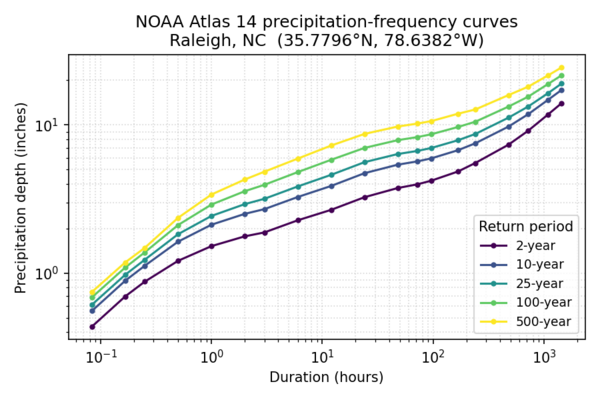
Figure: Precipitation-frequency (depth vs. duration) curves for Raleigh,
North Carolina, produced from an r.noaa.atlas14 mode=point query to the
NOAA Precipitation Frequency Data Server. Each curve is the expected value
for the labeled return period.
When multiple points are queried, JSON output is emitted as a list of
per-point result objects, and CSV output prepends lon,lat,bound columns so
rows from different points and bounds can be disambiguated. Single-point
output keeps the original unwrapped format for backward compatibility.
The statistic option controls whether PFDS returns precipitation depth or
intensity. The units option (english or metric) and series option
(pds or ams — partial-duration or annual-maximum series) are passed
through to PFDS.
If vector_output= is given, the module creates a vector point map with one
feature per queried point and columns lon, lat, expected_json,
upper_json, lower_json. Point geometries are reprojected from WGS84 into
the current project's CRS, while the lon/lat columns keep the original
WGS84 coordinates. The JSON
columns contain the full per-duration tables so they can be queried later with
v.db.select / db.select.
Grid mode
NOAA organizes Atlas 14 GIS archives under per-volume subdirectories of
base_gis_url=, e.g.
https://hdsc.nws.noaa.gov/pub/hdsc/data/se/ for Volume 9 Southeastern
States. When region= is given, autodiscovery fetches the listing at
<base_gis_url>/<region>/ and parses every *.zip href.
Filenames follow a compact convention
<region><ari>yr<NN><unit>a[l|u][_ams].zip, e.g.:
se2yr24ha.zip— Southeastern, 2-year ARI, 24-hour, expected, PDSorb1000yr30mau_ams.zip— Ohio River Basin, 1000-year, 30-minute, upper bound, AMSse1000yr60dal.zip— Southeastern, 1000-year, 60-day, lower bound, PDS
where <unit> is m, h, or d (minute/hour/day), bound is absent for the
expected value and l/u for the lower/upper 90% confidence bounds, and
_ams marks the annual-maximum series (absent = partial-duration series).
If autodiscovery fails or a custom mirror is used, pass archive_url=
directly with either a .zip URL or a directory listing URL that contains
the ZIPs.
The -l flag lists matching archives (as JSON lines) without downloading them.
Filtering behavior:
durations=andaris=are strict: candidates whose duration or ARI could not be inferred from the filename are rejected.bound=andseries=are permissive: a candidate with an unknown attribute is allowed through, to avoid discarding rasters whose filenames do not encode every attribute.statistic=andunits=do not filter archives in grid mode. NOAA only publishes depth in english units, so the module always downloads that and rescales the imported rasters to the requestedstatistic/unitsas output targets.
Rasters are imported with r.in.gdal by default; pass -i to use r.import
(which supports reprojection via resample=). Pass -o to override the
projection check when using r.in.gdal. Imported raster names follow the
pattern <output_prefix>_<statistic>_<bound>_<duration>_<ari>yr_<units>_<series>_<region>,
with missing parts omitted.
Value encoding
NOAA Atlas 14 GIS grids encode precipitation depth as integer 1000ths of
an inch in the raw archives. Grid mode converts the imported rasters
automatically, so no manual rescaling is needed: depth is written in inches
(or mm with units=metric) and intensity in in/hr (or mm/hr), according to
the requested statistic and units. The raster units and title set by
r.support describe the converted values. NODATA cells become GRASS NULLs on
import, so the sentinel value (which varies by volume) does not need to be
handled.
Safety
Extracted ZIP members are validated against path traversal (zip-slip): any member whose resolved path escapes the temporary extraction directory causes the import to abort.
EXAMPLES
Point query to CSV
r.noaa.atlas14 mode=point coordinates=-78.6382,35.7796 \
    statistic=intensity units=english series=pds bound=expected \
    format=csv output=/tmp/raleigh_idf.csv
Point query to JSON and create a vector point
r.noaa.atlas14 mode=point coordinates=-78.6382,35.7796 \
    statistic=depth units=english series=pds bound=all \
    format=json output=/tmp/raleigh_atlas14.json \
    vector_output=atlas14_raleigh
Multiple points as a single CSV and a multi-point vector
r.noaa.atlas14 mode=point \
    coordinates=-78.6382,35.7796,-80.8431,35.2271,-77.8868,34.2257 \
    statistic=depth units=english series=pds bound=expected \
    format=csv output=/tmp/nc_cities_idf.csv \
    vector_output=atlas14_nc_cities
Query the center of the current computational region
g.region raster=elevation
r.noaa.atlas14 mode=point format=json bound=expected
List matching grid archives without importing
r.noaa.atlas14 mode=grid region=se -l
Import a known archive directly
r.noaa.atlas14 mode=grid \
    archive_url="https://hdsc.nws.noaa.gov/pub/hdsc/data/se/se100yr24ha.zip" \
    output_prefix=a14 -i
Import filtered subset and write a manifest
r.noaa.atlas14 mode=grid region=se \
    durations=24hr,2day aris=10,100 bound=expected \
    output_prefix=a14 output=/tmp/a14_manifest.csv -i
REFERENCES
- Bonnin, G. M., D. Martin, B. Lin, T. Parzybok, M. Yekta, and D. Riley (2004–2019), NOAA Atlas 14: Precipitation-Frequency Atlas of the United States. NOAA, National Weather Service, Silver Spring, Maryland.
- NOAA Precipitation Frequency Data Server (PFDS): https://hdsc.nws.noaa.gov/pfds/
SEE ALSO
AUTHORS
Corey T. White, NCSU GeoForAll Lab
SOURCE CODE
Available at: r.noaa.atlas14 source code
(history)
Latest change: Wednesday Jun 03 10:49:06 2026 in commit cb384e4